Hill House
Under Your Spell: A Romance Boxed Set of Masked Balls, Haunted Gardens, Magic, and MoreHill House is Collier Michael Dunne’s Victorian mansion above Seagrove, a house whose physical isolation and supernatural atmosphere make it far more than a residence. It serves simultaneously as shelter, workplace, threshold, and threat: Clementine Lillian Noor Silver Yasmeen Salem Hagley arrives seeking its owner and a place to stay, discovers a room suited to concentrated study, encounters signs of violence within it, and finally leaves with Collier Michael Dunne under circumstances that make the house’s apparent protection feel uncertain.
Setting and Approach
Hill House stands at the top of the only visible hill near Seagrove. The surrounding country rises no higher than gentle sand dunes; west of the town lie salt marshes and pine forests. From a distance the mansion seems deceptively unreachable, taking far longer to approach than its apparent position suggests. Its elevation separates it from ordinary town life before anyone crosses the property line.
The approach establishes the house through autumnal Gothic imagery. Bare trees resemble skeletons, their dark branches reaching like bony fingers, while a raven flies from a high branch with a cry. The grass is rank, the shrubs ragged with neglect, and the failing light leaves the mansion stark and lonely. Holly and yew line the path, and ivy covers much of the brick facade. Silver recognizes these evergreen plants as traditional protections against evil, even while acknowledging that they also belong to ordinary gardens. The ambiguity matters: the house’s defenses may be magical, symbolic, or merely natural, but they make the property appear to possess a will of its own.
At the iron gate marking the boundary of Collier Michael Dunne’s property, Silver pauses after feeling a warm tingle that may be a protective spell or simply the effect of freezing mist. The gate therefore functions as more than an entrance. It is the first point at which ordinary interpretation gives way to supernatural possibility, and the uncertainty prevents the house from being classified securely as either haunted or safe.
Arrival and Interior Refuge
Silver reaches Hill House carrying Piewicket’s case in one hand and a small suitcase in the other. She is already indignant because Coll has left her waiting at the station, yet her anger is joined by practical anxiety: she has feared that he might not be present and that she would be left without shelter. A few faintly glowing windows reassure her that the house is occupied. After setting the cat and luggage on the porch, she strikes the iron door knocker; its sound reverberates through the mansion, but no footsteps answer.
The delayed response turns hospitality into suspense. Hill House appears inhabited but does not behave like an ordinary home, and its silence makes Silver confront the possibility that its owner may be inaccessible even while the building visibly contains life. The threshold offers no immediate welcome. Instead, the house makes her wait before allowing her inside, establishing a recurring pattern in which access, knowledge, and safety are never freely granted.
Once Silver is settled, Hill House contains a remarkably suitable intellectual retreat. Collier Michael Dunne shows her to the third floor, a single large study with bookcases built between window bays on both sides. The walls slope inward toward a small square cupola whose glass windows sit at the center of the roof. There is no fireplace, but a wood-burning stove occupies one corner; a desk stands in the middle of the room, with a leather chair nearby. Silver is delighted by the space. The upper room’s books, windows, stove, and concentrated architecture make it a refuge for study, while its separation at the top of the house also gives it the privacy and exposure characteristic of an attic-like observatory.
Disturbance and Hidden Violence
The house’s scholarly promise is undermined by Silver’s increasingly troubled nights. When the disturbance happens again, she wonders whether the spellbook is affecting her mind or concealing a curse that strikes anyone who reads it. She then attempts to rationalize the experience as the result of hard work, intense effort, poor sleep, and the strain of living in an unfamiliar place. Her hunger supplies an ordinary reason to leave her room, but the house’s silence immediately makes the excursion feel dangerous.
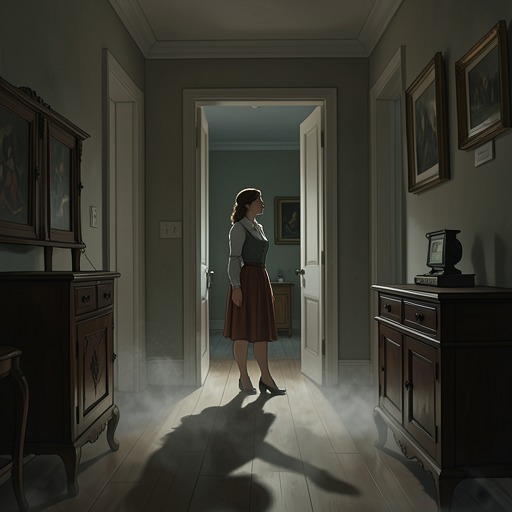
Wrapped in a robe over her nightgown, Silver unlocks her door and creeps down the stairs. She assumes Collier Michael Dunne is asleep and imagines Piewicket curled somewhere or out hunting. In the kitchen she switches on the light and notices dark red spots near the back door. Kneeling, she touches the sticky wetness and smells the unmistakable copper-and-iron scent of fresh blood. Her instinctive response is flight rather than investigation. The blood converts Hill House from an unsettling environment into a site of possible bodily harm, while the back door links the domestic interior to an unseen exterior intrusion.
The discovery also changes the meaning of the earlier signs. The protective plants, the magical sensation at the gate, the silent stairs, and the absent response at the front door no longer belong only to Gothic atmosphere. They become part of a pattern in which Hill House conceals danger behind ordinary domestic arrangements. The building’s rooms do not simply contain secrets; they regulate when those secrets become visible.
Departure and Narrative Significance
About an hour before the train is due at Seagrove station, Collier Michael Dunne locks the front door and announces that it is time to leave. His attitude toward the property has changed sharply: he says that someone can look in on it and that, at this point, it could even burn to the ground because he no longer needs it. He smiles while explaining that he now has what he wants. The remark detaches the house from permanence and turns it into something expendable, a former refuge whose value has been superseded.
Silver urges him to return to work, but Piewicket insists that they should move on as soon as possible. Their departure is therefore both practical and pressured. Hill House has offered a study and shelter, yet it has also produced sleeplessness, fear, and the discovery of fresh blood. The characters do not resolve the house’s mysteries before leaving; instead, they withdraw from a space whose meaning remains unstable.
As Silver and Collier Michael Dunne pass the gate, a cold gust rises up the hill beneath dark grey clouds. A gentleman’s hat tumbles to a stop at Silver’s feet, and fear seizes her. Piewicket begins yowling from its case while Coll stops and looks around. The final movement returns the narrative to the threshold where the house’s supernatural possibility first emerged. Hill House is left behind physically, but its boundary remains active in the characters’ perception, making departure feel less like escape than a tense interruption in the house’s claim upon them.
Architectural and Thematic Function
Hill House organizes fear through contrasts between shelter and exposure, scholarship and violence, protection and entrapment. Its upper study promises order through books, a desk, and a stove, while the neglected grounds and unresponsive entrance make the same residence feel abandoned. Even the vegetation carries two readings: holly, yew, and ivy may signify protection, but the ivy also seems intent on smothering the facade. The house thus embodies an uncertainty central to the supernatural narrative: a defense against evil may resemble the growth of evil itself.
Its spatial design gives the building an active narrative role. The hill delays approach; the gate marks a possibly enchanted boundary; the porch withholds welcome; the silent stairway leads to blood; and the locked front door later becomes the object of a deliberate final departure. Hill House guides movement while limiting understanding. It is a refuge that cannot fully protect, a workplace that cannot remain neutral, and a home whose most decisive revelations occur at its edges.
The mansion’s importance lies less in any confirmed explanation than in the way it makes every explanation provisional. Silver repeatedly tries to reduce uncanny experience to fatigue, cold, or circumstance, but the house continually supplies details that resist such simplification. Its lasting effect is therefore atmospheric and structural: Hill House transforms arrival into apprehension, domestic life into investigation, and leaving into another encounter with the unseen.